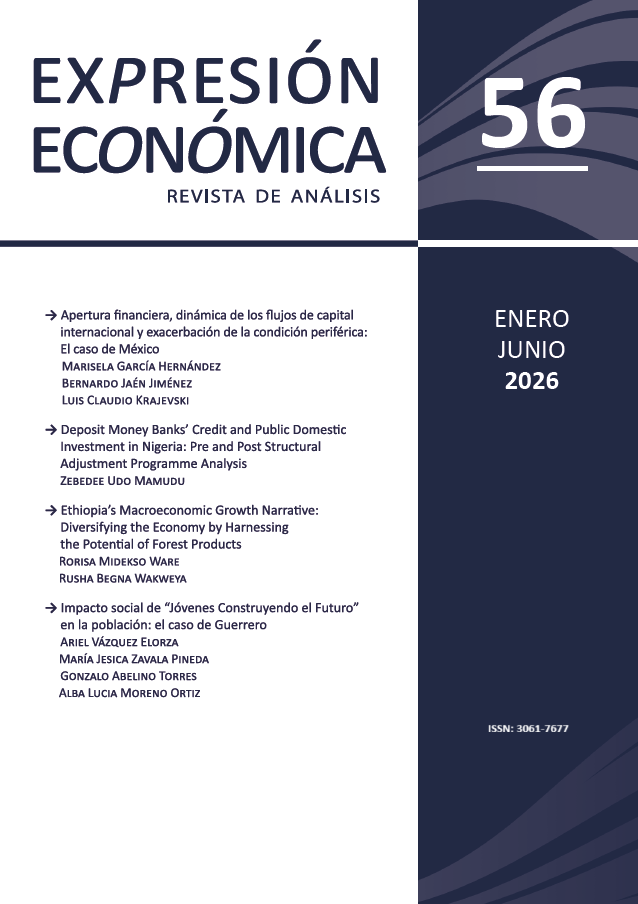
Social Impact of “Jóvenes Construyendo el Futuro” on the Population: The Case of Guerrero
DOI:
https://doi.org/10.32870/eera.vi56.1232Keywords:
impact evaluation, income, Guerrero, beneficiariesAbstract
This study evaluated the causal impact of the Jóvenes Construyendo el Futuro (JCF) Program on income and working conditions using Propensity Score Matching among Mexican youth aged 18 to 29, comparing beneficiaries and non-beneficiaries residing in the state of Guerrero for the year 2022. This corresponds to 160,301 beneficiaries and 337,994 non-beneficiaries using the expansion factor, for a total sample of 498,295 observations. The socioeconomic characteristics of the two groups, including access to health care, housing deprivation, educational level and gender, were compared according to propensity score matching (PSM) methodology. The results show that participants experience a significant increase in income, particularly in state transfers and labor income, although the effects vary depending on factors such as food insecurity, housing quality and social security. Analyses showed that those who were already employed and those in housing poverty were less likely to participate. Analyses also showed that women were more likely to participate than men. To maximize the benefits of the initiative more equitably, it is recommended that program targeting be strengthened to ensure that disadvantaged youth also benefit and have easier access to basic services.
Downloads
Published
Issue
Section
License
Copyright (c) 2025 Expresión Económica. Revista de análisis

This work is licensed under a Creative Commons Attribution-NonCommercial-NoDerivatives 4.0 International License.