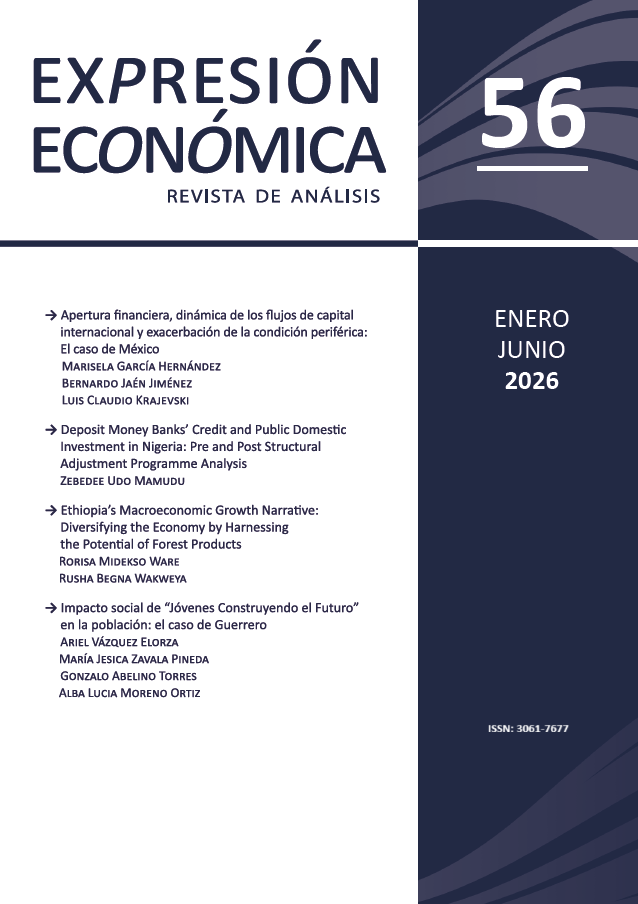
Financial Liberalization, Dynamics of International Capital Flows, and the Exacerbation of Peripheral Condition: The Case of Mexico
DOI:
https://doi.org/10.32870/eera.vi56.1229Keywords:
latin american economies, mexican economy, macroeconomics, financial globalization, neoliberalismAbstract
This paper analyzes the effects of financial liberalization on key macroeconomic variables in peripheral countries, with a particular focus on the Mexican economy. It begins by theoretically addressing how the extreme volatility of capital flows, resulting from monetary asymmetry and speculative dynamics, leads to negative macroeconomic effects for the periphery. Subsequently, it verifies how this volatility affected the exchange rate, inflation, and GDP of Mexico during the period from 1980 to 2000. The results demonstrate how abrupt capital outflows trigger and reinforce macroeconomic imbalances in countries with lower-tier currencies, in addition to restricting their autonomy to use macroeconomic instruments. In this context, Mexico's financial liberalization resulted in high macroeconomic vulnerability to speculative shocks on its currency.
Downloads
Published
Issue
Section
License
Copyright (c) 2025 Expresión Económica. Revista de análisis

This work is licensed under a Creative Commons Attribution-NonCommercial-NoDerivatives 4.0 International License.